

When sourcing HA dermal fillers for an aesthetic business, you may come across technical terms such as cross-linking, viscosity, G′ (G prime), elasticity, and cohesivity.
Many buyers focus primarily on HA concentration, price, or brand reputation. However, these factors alone do not fully describe how a dermal filler will behave during injection or after placement.
Cohesivity is one of the important physicochemical properties used to characterize HA dermal fillers. It describes the internal forces that help the gel maintain its integrity when subjected to compression, stretching, or other mechanical forces.
For B2B buyers, understanding cohesivity can help when comparing different HA filler formulations, reviewing technical specifications, and matching products with different treatment requirements.
What Exactly Is HA Filler Cohesivity?
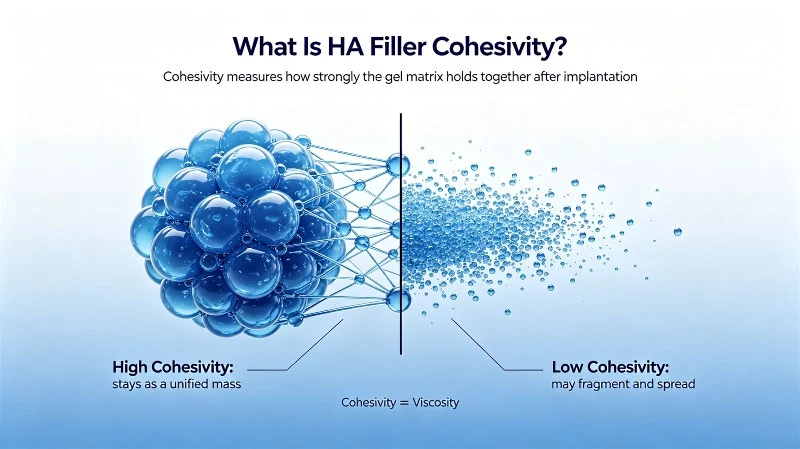
Cohesivity refers to the internal adhesion forces that hold the cross-linked HA components of a gel together.
In simple terms, it describes how well the filler maintains its integrity when mechanical forces are applied.
A useful analogy is food texture:
Highly cohesive gel:
Similar to a firm jelly that tends to deform as a relatively unified mass when pressure is applied.
Less cohesive gel:
More like a softer gel that can separate or disperse more readily when subjected to mechanical forces.
However, this analogy should not be taken to mean that higher cohesivity is always better. Different filler formulations are designed with different combinations of rheological and physicochemical properties for different applications.
Cohesivity vs. Viscosity
Cohesivity and viscosity are related to gel behavior, but they are not the same property.
Viscosity describes a material's resistance to flow under applied shear.
Cohesivity describes the internal integrity of the gel and its resistance to separation under compression or stretching.
A filler can therefore have a particular viscosity profile without necessarily having the same cohesivity as another filler.
This is why comparing HA fillers based on a single parameter can be misleading.
How Does Cohesivity Affect HA Filler Performance?
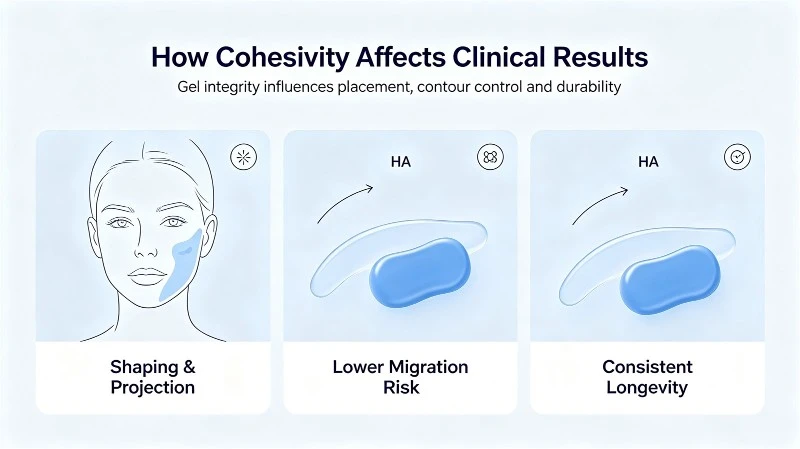
Cohesivity is one part of the overall performance profile of an HA dermal filler. Its practical significance becomes clearer when considered together with G′, G″, tan δ, viscosity, HA concentration, swelling behavior, particle structure, and cross-linking technology.
1. Gel Integrity and Tissue Support
A more cohesive HA gel can maintain its integrity when subjected to mechanical stress.
This characteristic can be valuable when a filler is expected to provide volume, projection, or structural support.
For example, products intended for deeper tissue placement or contouring may be formulated with a combination of rheological properties that provide sufficient firmness, elasticity, and cohesivity.
However, cohesivity should not be interpreted as a standalone indicator of lifting capacity. G′, elasticity, injection depth, product formulation, and tissue characteristics also influence the final result.
2. Gel Spread and Tissue Distribution
Different HA fillers can behave differently after injection.
Some formulations are designed to remain relatively localized, while others are formulated to integrate and spread more easily within the tissue.
Cohesivity contributes to this behavior, but it is not the only factor involved. Viscosity, elasticity, particle characteristics, and the overall gel structure can also influence how a filler distributes within soft tissue.
For this reason, it is better to think of cohesivity as one component of filler behavior rather than a direct measurement of migration risk.
3. Injection and Handling Characteristics
Practitioners often consider how a filler behaves during extrusion, placement, and molding.
A filler with a particular combination of viscosity, elasticity, and cohesivity may provide a specific balance between:
- Injection control
- Moldability
- Shape retention
- Tissue integration
- Resistance to mechanical deformation
Importantly, cohesivity alone does not determine injectability.
Needle size, extrusion force, viscosity, gel structure, temperature, and other formulation characteristics can all affect the injection experience.
4. Long-Term Performance
It is tempting to assume that a highly cohesive filler will always last longer.
This is an oversimplification.
The longevity of an HA filler depends on multiple factors, including:
- Degree and type of cross-linking
- HA concentration
- Cross-linking technology
- Gel structure
- Enzymatic degradation
- Injection depth
- Treatment area
- Mechanical forces within the tissue
Cohesivity may contribute to the overall behavior and stability of the gel, but it should not be presented as a direct predictor of filler longevity.
High, Medium, and Low Cohesivity: What Do These Categories Mean?
HA fillers are sometimes broadly discussed as having high, medium, or low cohesivity.
These categories can be useful for explaining general gel behavior, but buyers should be careful when comparing products from different manufacturers.
There is currently no universally standardized cohesivity testing method that allows every HA filler to be ranked directly on one identical scale.
High-Cohesivity Formulations
Generally associated with stronger gel integrity and greater resistance to separation under mechanical stress.
They may be considered when structural support, projection, and shape retention are important.
Typical applications may include:
- Chin contouring
- Jawline definition
- Deep volume restoration
- Structural facial augmentation
However, the appropriate indication depends on the complete rheological profile and the manufacturer's clinical specifications.
Medium-Cohesivity Formulations
These may offer a balance between gel integrity, moldability, and tissue integration.
They can be suitable for applications where both moderate structural support and natural tissue behavior are desired.
Potential applications include:
- Mid-face volume restoration
- Nasolabial folds
- Marionette lines
- Moderate contour correction
Again, cohesivity should be evaluated together with G′, viscosity, elasticity, and intended injection plane.
Lower-Cohesivity Formulations
Lower-cohesivity gels may be more capable of spreading or integrating within tissue.
Depending on their overall rheological characteristics, they may be considered for applications where softness, flexibility, and tissue integration are prioritized.
Potential applications can include:
- Superficial correction
- Fine-line treatment
- Lip applications
- More delicate soft-tissue enhancement
The important point is that low cohesivity does not automatically mean "better for hydration" or "for superficial injection." The final indication depends on the complete formulation and clinical design of the product.
Cohesivity vs. G′ vs. Viscosity: What Should B2B Buyers Check?
One of the most common mistakes when sourcing HA dermal fillers is trying to judge the product using only one number.
A more complete evaluation should consider several parameters together.
| Property | What It Describes | Why It Matters |
|---|---|---|
| HA Concentration | Amount of HA in the formulation | Influences overall gel characteristics |
| G′ (G prime) | Elastic/solid-like resistance to deformation | Helps describe firmness and resistance to deformation |
| G″ | Viscous component of the gel | Helps characterize flow and energy dissipation |
| Viscosity | Resistance to flow | Relevant to injection and handling |
| Cohesivity | Internal gel integrity | Helps describe resistance to separation |
| Swelling Factor | Water uptake and volume expansion | Relevant to volumizing behavior |
| Cross-linking | Structure created between HA chains | Influences rheology and degradation behavior |
This is why a professional HA filler supplier should be able to provide technical specifications and relevant test data, rather than relying only on marketing claims such as "high quality" or "long-lasting."
Why Cohesivity Matters When Choosing an HA Filler Supplier
For aesthetic clinics, distributors, and wholesale buyers, technical documentation can be just as important as the product itself.
When evaluating an HA dermal filler supplier, consider asking for:
1. Technical Specifications
Ask for relevant information such as:
- HA concentration
- G′ / G prime
- G″
- Viscosity
- Cohesivity or cohesion test results
- pH
- Osmolality, where applicable
- Swelling characteristics
- Particle or gel structure information
Not every manufacturer will provide every parameter, and test methods may differ.
2. Test Method for Cohesivity
This is particularly important.
Because cohesivity does not currently have one universally accepted standardized testing method, the test method and measurement conditions should be reviewed before comparing numbers between suppliers.
A cohesivity value from one laboratory may not be directly comparable with a value generated using a different test method.
3. Batch-to-Batch Consistency
For wholesale and distribution businesses, consistency is critical.
Ask whether the supplier can provide:
- Batch-specific COA
- Quality-control records
- Sterility testing
- Endotoxin testing
- Physicochemical specifications
- Stability data
- Manufacturing and quality certifications
This allows buyers to evaluate not only the product specification but also the manufacturer's ability to maintain consistent quality.
4. Intended Clinical Application
Do not select a filler simply because it has a "high G′" or "high cohesivity."
Instead, evaluate whether the overall formulation is appropriate for the intended treatment area and injection plane.
A professional supplier should be able to explain the intended positioning of each product in its range.
Common Mistakes When Buying HA Dermal Fillers
Mistake 1: Choosing Based Only on HA Concentration
A higher HA concentration does not automatically mean better clinical performance.
Different manufacturing and cross-linking technologies can produce very different gel characteristics even when HA concentrations are similar.
Mistake 2: Assuming Higher Cohesivity Is Always Better
High cohesivity can provide advantages in certain applications, but it is not universally superior.
The ideal filler depends on the desired balance of firmness, elasticity, cohesivity, viscosity, swelling, and tissue integration.
Mistake 3: Comparing Cohesivity Numbers Without Checking the Test Method
Different testing methods can produce different measurements.
Always check how the cohesivity value was obtained before using it to compare products from different manufacturers.
Mistake 4: Treating G′ as the Only Quality Indicator
G′ is an important rheological parameter, but it is only one part of the picture.
A professional product evaluation should consider the complete physicochemical profile.
Key Takeaways for B2B Aesthetic Buyers
When sourcing HA dermal fillers for your clinic, distribution business, or aesthetic brand:
1. Look beyond HA concentration.
Consider G′, viscosity, cohesivity, swelling behavior, and cross-linking technology together.
2. Do not treat cohesivity as a standalone quality score.
Its meaning depends on the complete formulation and intended application.
3. Check the test method.
Cohesivity measurements are not yet standardized across all manufacturers.
4. Match product properties with treatment requirements.
Different injection areas may require different combinations of elasticity, firmness, viscosity, and cohesivity.
5. Request technical documentation.
COA data, quality-control information, stability data, and relevant certifications can help you evaluate supplier reliability.
6. Prioritize batch consistency.
For distributors and clinics, consistent product specifications are essential for long-term purchasing and customer confidence.
Conclusion
HA filler cohesivity is an important concept in understanding how a dermal filler behaves under mechanical stress.
However, cohesivity should not be viewed in isolation.
The performance of an HA dermal filler is influenced by the interaction of multiple factors, including HA concentration, cross-linking technology, G′, G″, viscosity, swelling behavior, gel structure, and the intended treatment application.
For B2B buyers, the best approach is not simply to look for the "highest cohesivity" filler. Instead, evaluate the complete technical profile, testing methodology, quality documentation, and intended application before selecting a supplier or product line.
A reliable HA dermal filler supplier should be able to provide transparent technical information and explain how its products are designed for different aesthetic applications.


